How Much Does It Cost to Advertise on Screens in Cafes, Restaurants and Gyms?
Real 2026 pricing for indoor screen advertising: CPM benchmarks by venue type, minimum budgets, hidden costs, and how to judge whether a quote is fair.
Advertising on indoor screens in cafes, restaurants and gyms typically costs between $8 and $30 per thousand impressions (CPM), or roughly $500 to $5,000 per month for a direct buy on a small indoor network. Most established networks also enforce a minimum spend of $1,000 to $5,000 on programmatic buys and $5,000 to $25,000 on direct buys, which is exactly why most small and mid-sized businesses never try the channel at all.
That last number is the real story, and it is the one this guide spends the most time on. Below is what the channel actually costs, what drives the price up and down, how to tell a fair quote from a bad one, and how to test screens without committing a budget you do not have yet.
Why there is no list price for screen advertising
Two screens 200 metres apart in the same city can differ by four times in cost, because you are not buying the screen. You are buying access to the people standing in front of it.
Three things vary between every quote you will receive:
- What you are being charged for. Impressions, hours, plays, or a flat monthly fee. These are not interchangeable.
- How the audience number was calculated. In out-of-home, an impression is an estimate of exposure opportunity, not a verified one-to-one view like a web banner. The industry separates this into tiers such as Gross, Opportunity to See (OTS) and Likelihood to See (LTS).
- What the venue context is worth. A screen beside a gym cardio row reaches someone standing still for 25 minutes. A screen in a hallway reaches someone walking past in three seconds. Same hardware, very different value.
If a quote does not make all three explicit, it is not a price. It is a number.
The four pricing models you will encounter
CPM: cost per thousand impressions
The dominant model, and the one used in all programmatic buying. You pay for estimated audience reached, which makes screen advertising directly comparable to your web and social spend. CPM requires the network to actually measure its audience. If a network quotes a CPM but cannot explain where the impression figure comes from, treat the proposal as incomplete.
CPH: cost per hour
The older, simpler model. You buy an hour of screen time and your spot runs in rotation. No sensors and no audience proof required. It is transparent and easy to verify, but it tells you nothing about how many people saw the ad. Common with smaller local networks that have not built measurement infrastructure yet.
CPV: cost per play
You pay each time your spot plays, regardless of who was there. Self-serve platforms have pushed this floor very low, with some publishing per-play rates starting at a single cent.
Flat monthly rate (share of voice)
You buy a fixed share of a screen loop for a month. Predictable and easy to budget, and common in direct buys, but you carry the risk if foot traffic underperforms.
What it actually costs, by venue type
These are 2026 market benchmarks compiled from public DOOH marketplace and measurement data. Treat them as directional, since your market and season will move them.
| Placement | Typical CPM | Notes |
|---|---|---|
| Cafe and restaurant screens | $8 - $20 | High dwell time; food and beverage brands pay a premium |
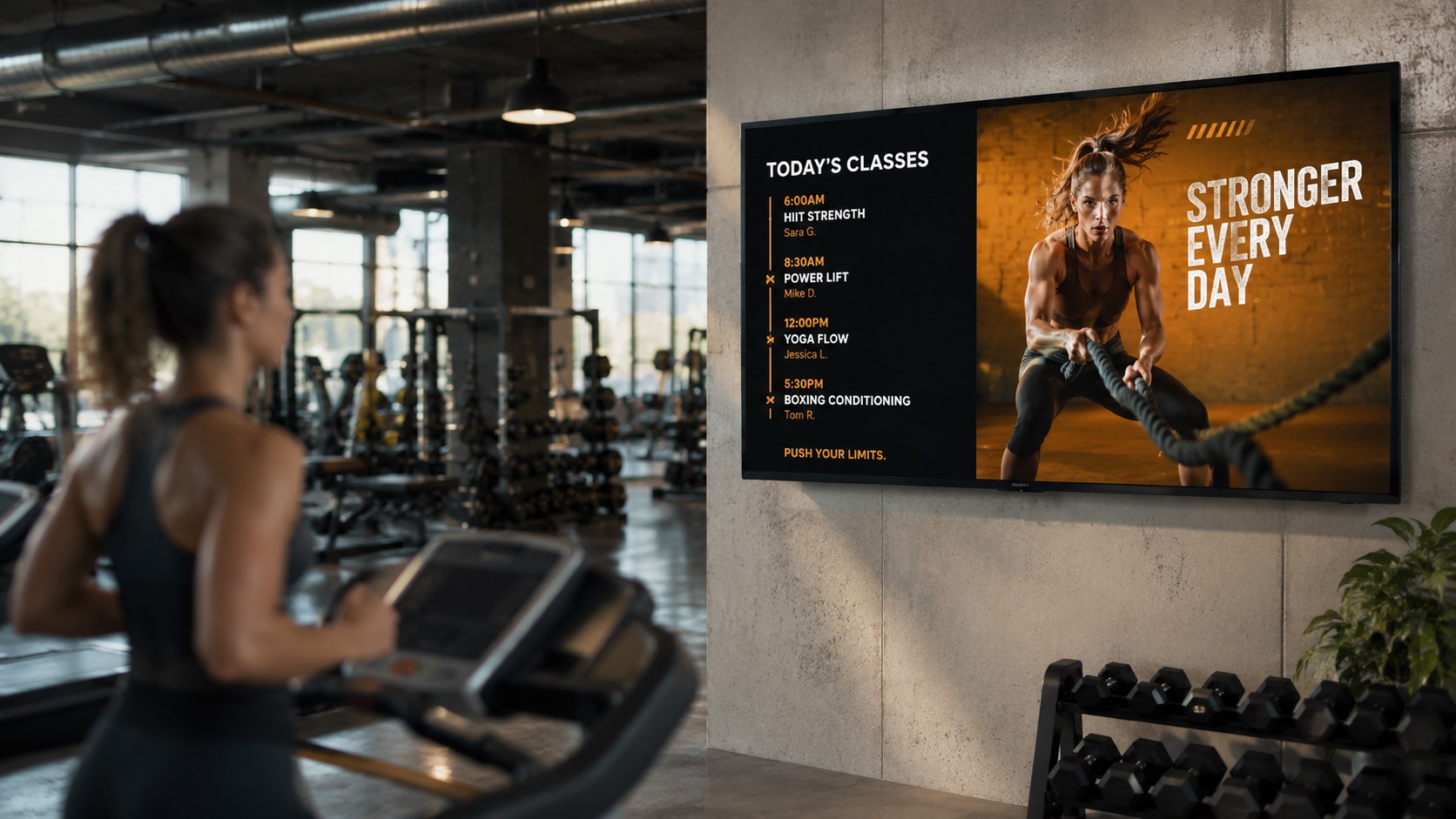
| Gym cardio-zone screens | $12 - $25 | Long dwell, captive attention, health-conscious audience |
| Gym lobby video walls | $15 - $30 | Higher visibility, entry and exit exposure |
| Premium gym mirror displays | $18 - $35 | Newest format, scarcity premium |
| Office lobbies and residential towers | $10 - $25 | B2B premium in business districts |
| Retail and mall screens | $8 - $20 | Broad reach, lower intent |
| Hotel lobbies and lounges | $10 - $22 | Travel, leisure and premium retail advertisers |
| Healthcare waiting rooms | $15 - $25 | Highest precision, highest CPM |
| Programmatic open exchange (mixed) | $4 - $10 | Cheapest entry, least venue control |
| Premium roadside or landmark LED | $25 - $75+ | Not comparable to indoor place-based screens |
For monthly flat-rate buys, indoor networks in malls, pharmacies and similar controlled environments generally run $500 to $5,000 per month, against $1,500 to $30,000 per month for roadside digital billboards.
A useful sanity check: if you are quoted more than $30 CPM for everyday indoor inventory with no high-intent venue context, no audience data overlay and no exclusivity, ask what justifies the premium. Frequently, nothing does.
The minimum-spend problem
This is where most local gyms, boutique brands, cafe owners and regional SMEs get stopped.
- Programmatic DOOH campaigns commonly require minimums of $1,000 to $5,000 per market, and many demand-side platforms set the floor at $5,000 to $10,000.
- Direct buys with a media owner typically start at $5,000 to $25,000 per market.
- Test campaigns on the major self-serve platforms in large cities start around $1,500 to $2,500.
None of those numbers work for a business that wants to spend a small amount to find out whether screen advertising does anything for them. The channel has effectively been priced for enterprise advertisers and agencies, and the long tail of local businesses, the ones with the most to gain from advertising inside venues in their own neighbourhood, has been locked out by minimums rather than by CPM.
The costs that do not appear in the CPM
Budget for these separately, or your effective cost per thousand will be far higher than the number on the proposal.
- Creative production. A 10 to 15 second motion spot from an agency runs from a few hundred to several thousand dollars. Static and simple animated creative costs far less and often performs comparably on indoor screens.
- Format adaptation. Portrait, landscape, video wall and mirror are each a separate export. Get the full spec sheet before you brief a designer.
- Platform and serving fees. In programmatic chains, historically only around 50 to 65 percent of media spend reached the media owner. Programmatic DOOH is leaner, at roughly a 10 to 30 percent take, but it is not zero.
- Measurement studies. Footfall lift and brand lift studies are usually priced on top of media and carry their own minimums.
- Approval turnaround. Not a cash cost but a schedule cost. Some networks take days to review creative.
Five questions that separate a fair quote from a bad one
- How is an impression defined here, and who audited it? A network with no third-party measurement is not necessarily bad, but it should be selling you hours or plays, not impressions.
- What is the loop length, and what is my share of voice? A 10-slot loop means your spot appears once every 10 plays. A 60-slot loop is a very different product at the same CPM.
- Which specific venues, and what are their opening hours? A large screen count is meaningless if most of them sit in venues your audience never enters.
- What reporting will I receive, and how often? Plays, verified delivery, screen-level breakdown, timestamped. Weekly at minimum.
- Can I stop or change the campaign mid-flight? Programmatic yes; most direct buys no.
Any network that cannot answer all five in writing is asking you to buy on faith.
Is it worth it? An honest read
Indoor place-based screens do something web and social advertising structurally cannot: they reach a person in a physical context where their intent is already known. A protein brand on a gym screen and a dessert brand on a cafe screen are both advertising to people who are, at that exact moment, in the mood for the category.
The trade-off is attribution. Out-of-home is strong on awareness and recall and weak on closed-loop, click-to-conversion tracking. Footfall studies and geo-lift measurement are directional, not definitive. If your business needs to attribute every unit of currency to a specific transaction, screen advertising will frustrate you. If you are building local awareness in specific neighbourhoods, it is one of the most efficient channels available.
Programmatic DOOH spend reached roughly $4.8 billion worldwide in 2026, up 28 percent year over year, with about a third of all DOOH now transacted programmatically. The money is moving toward this channel for a reason, and that reason is context and reach rather than last-click attribution.
This is also why most advertisers do not run screens alone. Pairing venue screens with website advertising and mobile app advertising gives you the physical-context reach of signage plus the measurable click layer that signage cannot provide on its own.
If you own the screens: what can you earn?
The other half of this question comes from cafe, restaurant and gym owners who already run screens for menus or promotions and want to know whether third-party ads are worth the space.
There is no lookup table for this. Revenue per screen is a calculation:
Monthly revenue = monthly impressions × fill rate × net CPM − platform share
Fill rate is the variable that decides everything. A screen with excellent foot traffic and a 15 percent fill rate earns less than a modest screen running at 70 percent. Below a certain fill rate, a monetised screen loses money every month no matter how cheap the hardware was. Any network that promises you a fixed monthly figure per screen without discussing fill rate is guessing.
A realistic, conservative starting point that many venues use: selling a handful of local promotional slots at around $50 per week across three screens produces roughly $7,800 a year. That is not transformative, but it comfortably covers the screens, the connectivity and the software, which turns your signage from a cost centre into a break-even asset before you count the uplift from your own promotions.
What to check before joining any network:
- Revenue share and payment terms. The percentage, and when you actually get paid.
- Category blocking. Can you refuse competitors or anything off-brand for your venue?
- Ad load. What share of the loop goes to third-party ads versus your own content?
- Hardware requirements. Do you need a dedicated media player, or will a Google TV or Android TV device you already own work?
- Exit terms. How long is the contract, and can you leave?
Where LenvoAds fits
We built LenvoAds around the gap described above: the minimum-spend barrier that keeps small and mid-sized advertisers out of a channel that would work well for them.
For advertisers
LenvoAds has a free tier. You can create an account, upload creative, target venues and dayparts, launch a campaign and see real delivery reporting without a media commitment. The free tier is capped and designed for testing and genuinely small local campaigns rather than national flights, with paid plans starting where those limits end. The point is that you can find out whether screens work for your business before you sign anything.
Because LenvoAds carries website and mobile app inventory alongside screens, a campaign can extend beyond the venue: the same brand, the same week, on the cafe screen and on the phone of the person sitting in front of it. See all three channels.
For venue owners
Listing your screens on LenvoAds is free. You keep control over which categories run in your venue and what share of the loop goes to third-party ads, and you can keep running your own menus and promotions alongside paid inventory. LenvoAds Display runs on Google TV and Android TV, so in most cases you do not need to buy dedicated signage hardware at all.
Start a free campaign List your screens
Last updated September 2026. Pricing benchmarks are directional and vary by market, venue and season.